Keys where the holes are
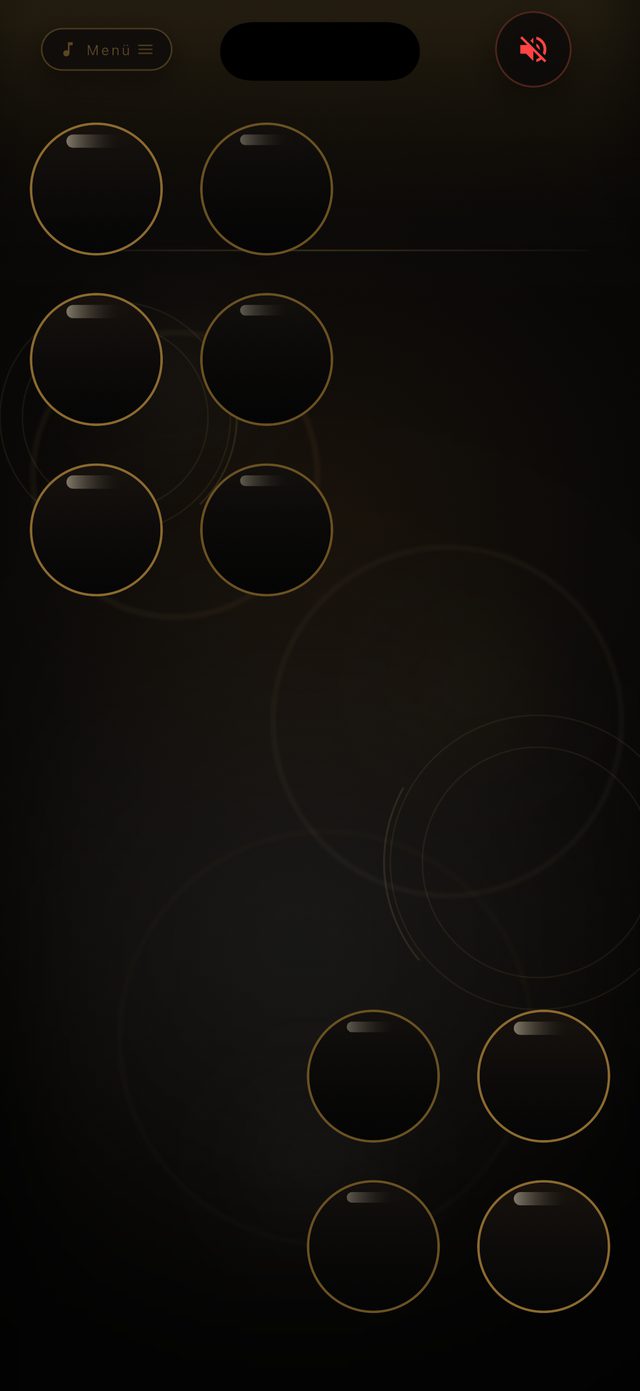
Three pairs for the upper hand, two for the lower, with either hand on top. A player’s muscle memory works from the first touch — there is no new fingering to learn.
 Tulum 4 is out now on the App Store and Google Play
The fourth generation
Not a soundboard. A playable instrument.
If you can play a real tulum, you can play Tulum 4. The fingering, the grip and the relationship between both chanters have been rebuilt as a playable digital instrument for iPhone, iPad and Android.
Why it’s real
The goal was never to record a tulum and put the recordings behind buttons. The interaction itself is based on the real instrument: the fingering, the grip, the two chanters and the ornaments work the way a tulum player expects them to.
You can’t fret the strings of a virtual guitar or draw a bow across a virtual violin. The tulum is different. Its goatskin bag keeps the air flowing without a break, so everything a player does — every note, every ornament, every slide — happens in the fingers. Put those fingers in the right places on glass, and the instrument is all there.
Three pairs for the upper hand, two for the lower, with either hand on top. A player’s muscle memory works from the first touch — there is no new fingering to learn.
The tulum’s double chanter sounds two pipes at once, and the small differences between them are its character. Tulum 4 plays both — the left pipe in the left channel, the right pipe in the right.
Tulum 4 recognises a çarpma from the same finger combination a player uses on the real instrument. Titretme and slides into the in-between notes of makam music come from the fingers, too.
Four sound sets recorded from the instrument itself, transposable in semitone steps, with the Uşşak and Nihavend makams — or scales you build yourself.
The design problem
On a real tulum, each finger lies flat across the double chanter and seals two holes at once; roll it slightly and one hole opens while the other stays closed. That small movement is part of how the instrument is played — and it is exactly what a sheet of glass cannot feel.
On glass you play with your fingertips, so Tulum 4 gives every pair of holes two keys — one closes both pipes, the other just one. The physical movement becomes a pair of touch targets, and every shape a rolling finger can make is still within reach.
Touchscreens report where a fingertip lands — not the shape of a finger lying across them. That is the one difference left. If iOS ever lets apps sense a finger lying flat, we can close this last gap too.
Twin chanters
The tulum’s chanter is two pipes side by side, played by the same fingers. Tulum 4 treats them as two pipes, not as one sound.
Every pair of holes has two keys: one closes both pipes, the other just one. As with a rolling finger on the real chanter, you choose whether both pipes change or only one.
The left pipe plays in the left channel, the right pipe in the right. Listen in stereo and you hear two pipes side by side, with the small differences between them intact.
When a take becomes notation, both chanters are drawn as two separate lanes, so you can read what each pipe played.
Two ways to play
Physical fingering. Digital instrument. For players who want a chanter in their hands, the Tulum MIDI Controller puts the fingering back on a physical body — and Tulum 4 turns it into sound.
The touchscreen is a complete tulum. Tune the size, shape and position of every key to your hands, choose key themes and colour palettes, and lock any hole closed for closed-tulum playing. Nothing else to buy.
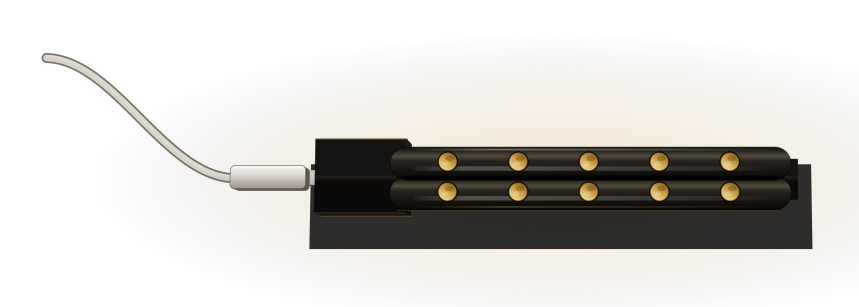
Shaped like the real double chanter, with ten brass touch points where the holes are. Plug it in and your fingers land exactly where they would on a tulum; Tulum 4 recognises it and maps every hole one to one.
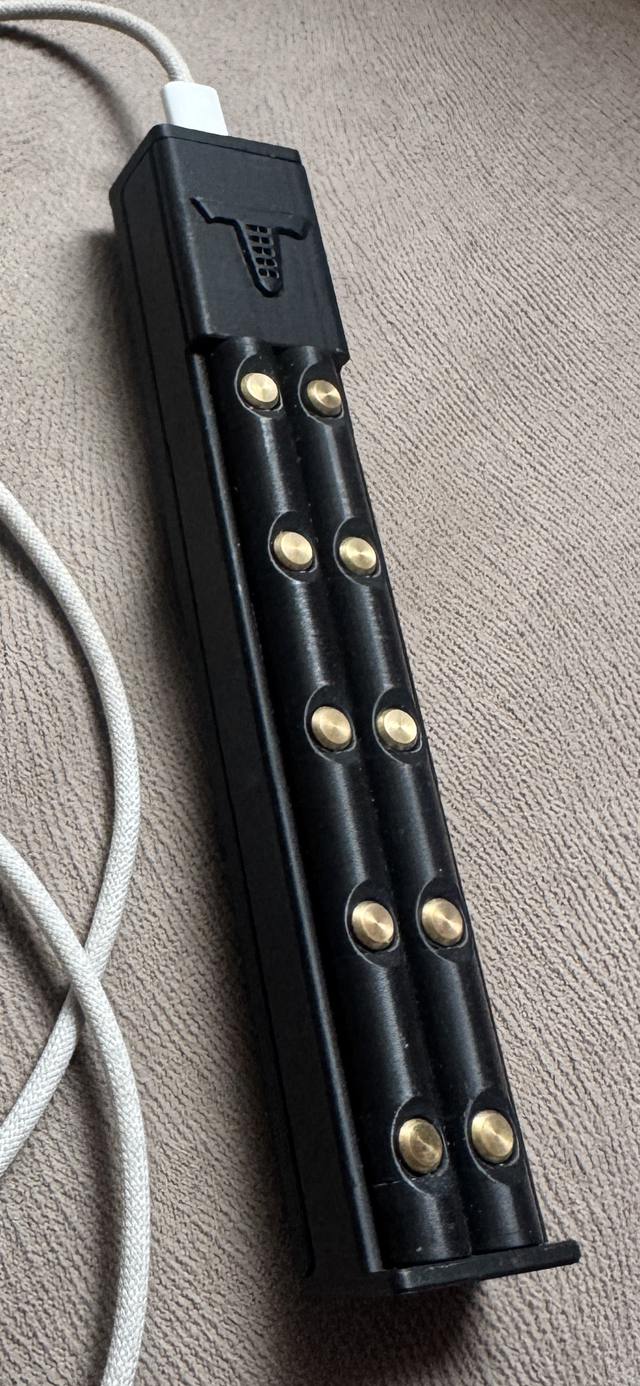
Made in small batches and sold separately — Tulum 4 is complete without it. For details and availability, message us on WhatsApp.
Learn
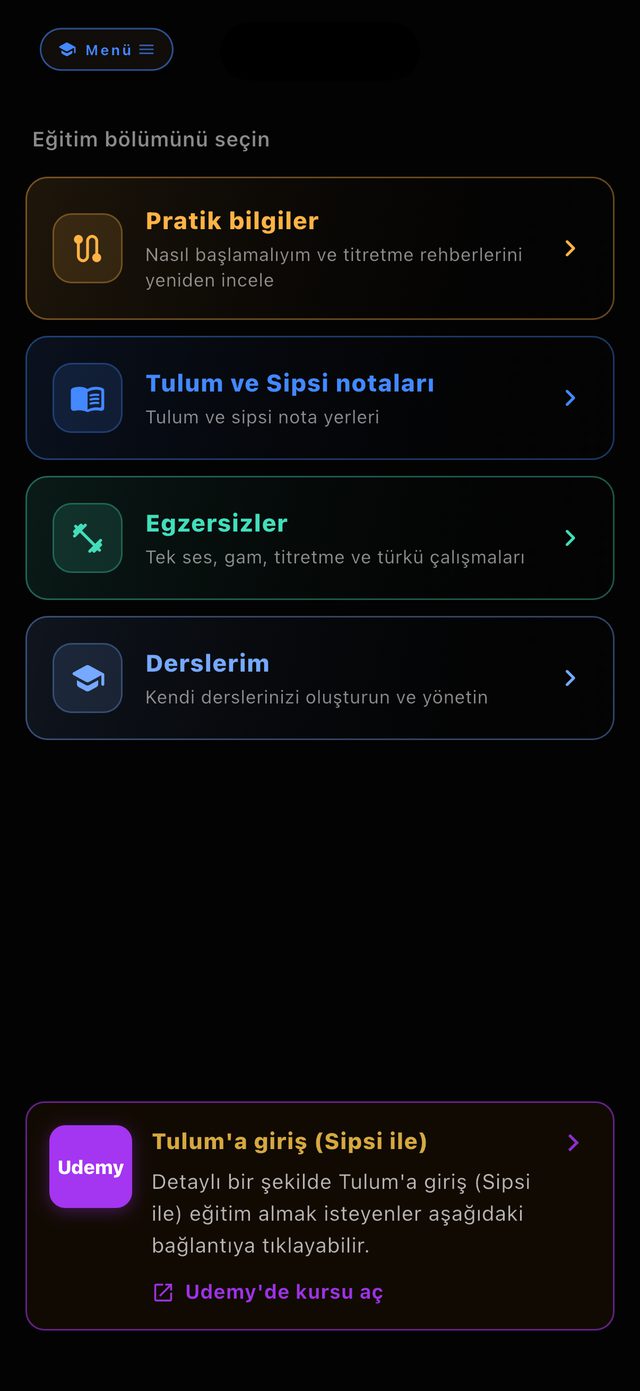
Tulum 4 is built to teach, not just to play — whether you have never held a tulum or you teach it.
.tlm file.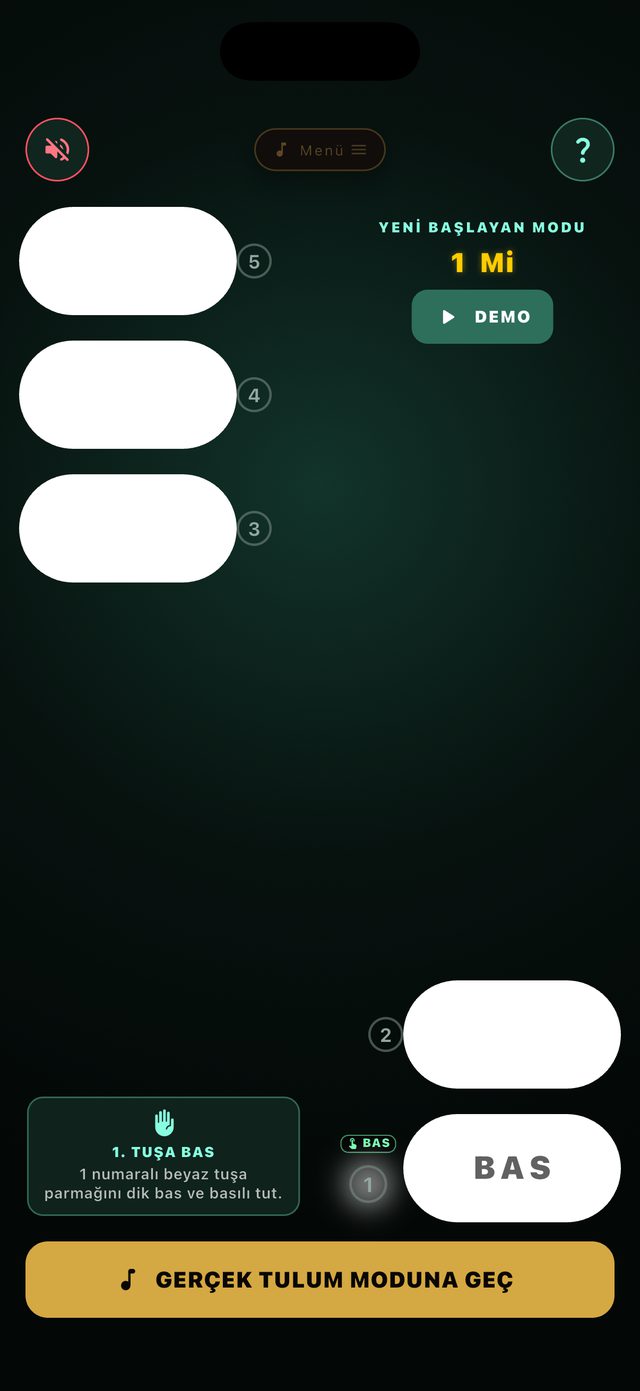
Record & score
Every take can become notation — and every file can leave the app.
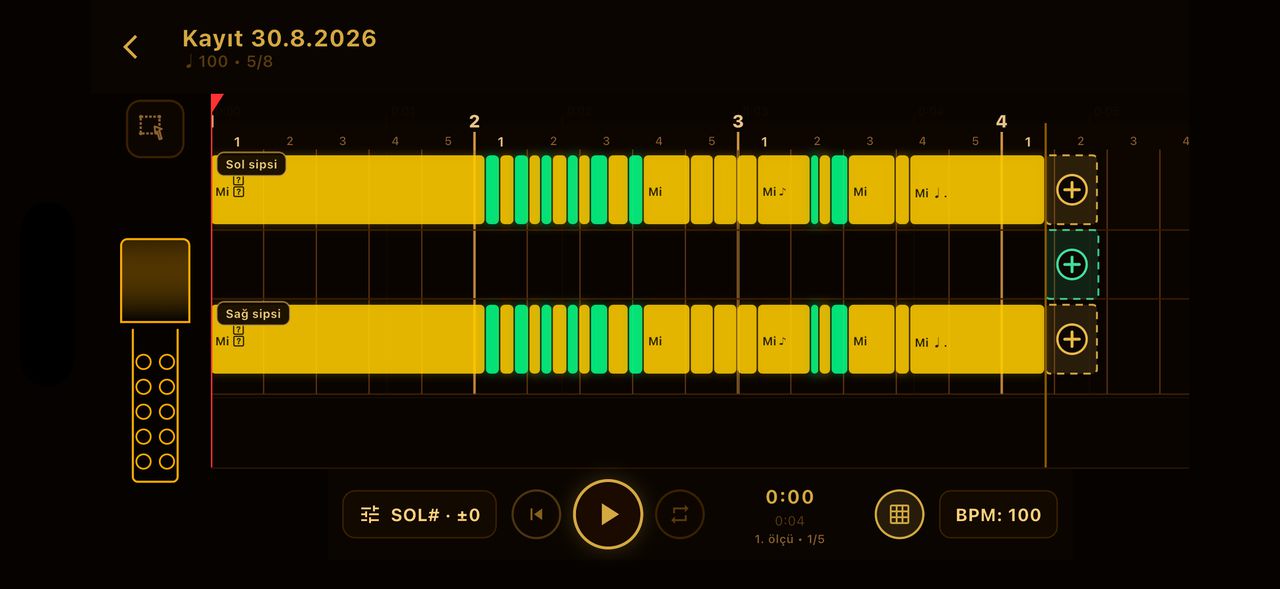
Record as you play and Tulum 4 turns the take into a score you can preview on A4.
Open the MIDI file in your DAW or notation software.
Reverb, chorus, vibrato, tremolo, compressor, ring modulator, bit crusher, room simulator and stereo widener — with room presets and your own saved chains.
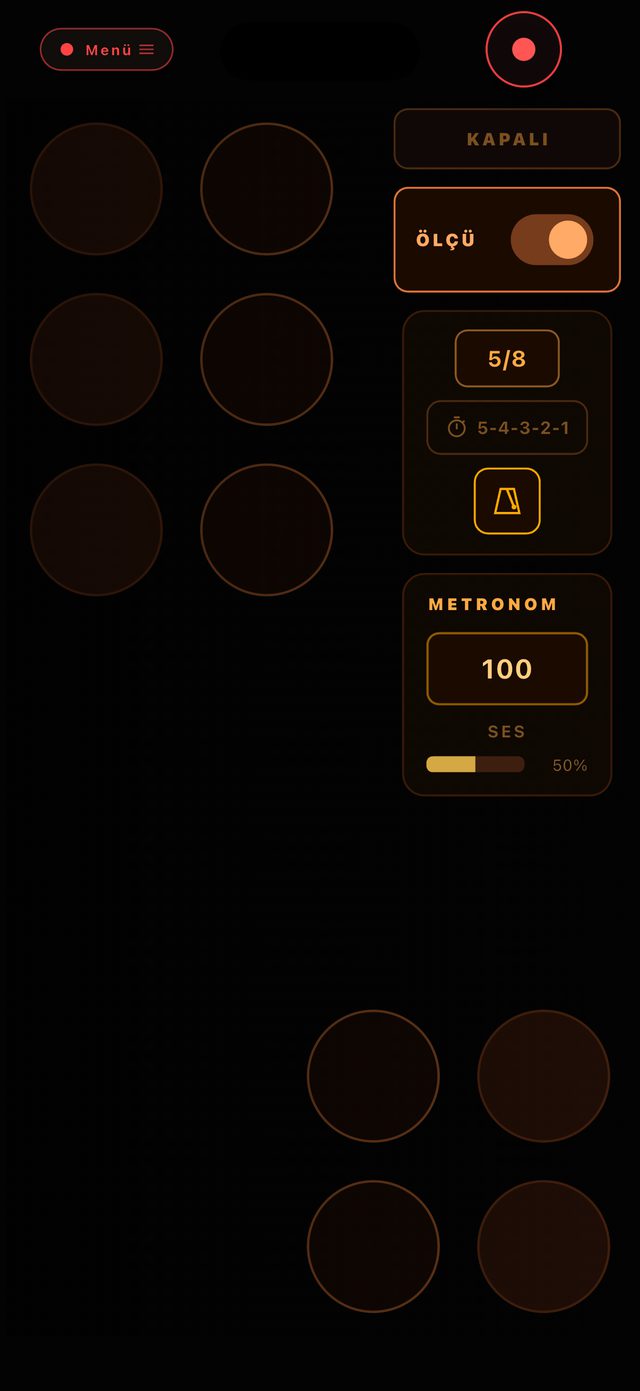
A metronome with BPM control and the region’s own time signatures, such as 5/8.
A sound with a memory
The tulum is the bagpipe of the eastern Black Sea — Rize, Trabzon, Artvin, Gümüşhane: a goatskin bag, a double chanter and a sound that never stops for breath. It carries the horon dances and the highland songs.
The app began with a single sentence. Davut Engin was looking for an idea for a mobile app and landed on a virtual instrument; he called tulum musician Selim Tarım, who answered: “Let’s make the tulum first.” Selim brought the sounds, the mentoring and the testing; Davut the software and, later, the electronics.
It did not stop at one app. Since 2012 the work has run through four generations, each one built by studying how the tulum is actually played and translating more of that behaviour into software — not by putting recordings behind buttons. Inside Tulum 4, an illustrated “Story of the Tulum” tells the rest.
Let’s make the tulum first.
The app and its story speak eleven languages
Four generations
4th generation · 2026
The real grip, both chanters, ornaments and slides, lessons, recording to notation and the Tulum MIDI Controller.
 3rd generation · 2020
Brought closed-tulum playing, with an adjustable number of closed holes.
 2nd generation
The second generation, still available for players who love the classic feel.
App Store 1st generation
Where the series began: the Black Sea tulum on a phone for the very first time.
App StoreFor press & App Store editors
Tulum 4 is a playable digital reconstruction of the Black Sea tulum for iPhone, iPad and Android, built around the real instrument’s fingering, twin chanters and performance behaviour.
Tulum 4 rebuilds the tulum — the double-chanter bagpipe of Turkey’s eastern Black Sea — as a playable digital instrument for iPhone, iPad and Android. Same fingering, same grip, both chanters in stereo, ornaments and slides from the fingers. Learn from zero, turn recordings into notation, or play it with the optional Tulum MIDI Controller.
A Black Sea instrument. A new way to play it.